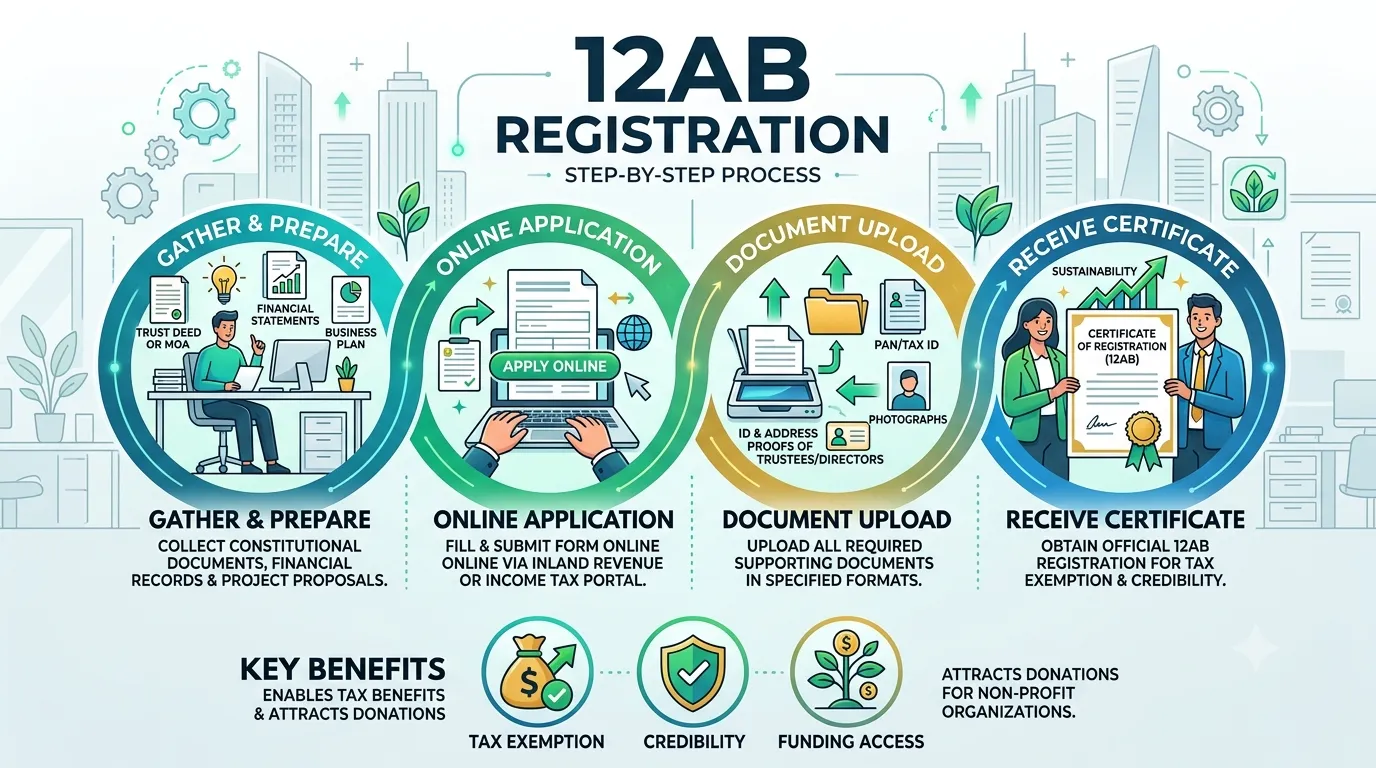
Non-governmental organisations (NGOs), charitable trusts, and other non-profit institutions play an important role in supporting education, healthcare, social welfare, poverty alleviation, and community development. However, to receive tax benefits and manage charitable funds effectively, eligible organisations must comply with the applicable provisions of the Income Tax Act, 1961.
One of the important requirements for such organisations is 12AB Registration. It provides eligible charitable and religious institutions with registration under Section 12AB of the Income Tax Act, allowing them to claim exemption on qualifying income, subject to prescribed conditions.
Whether you are establishing a new charitable trust or managing an existing NGO, understanding the eligibility, documents, application procedure, benefits, and renewal requirements of 12AB registration can help you maintain proper tax compliance.
What Is 12AB Registration?
12AB registration is a registration granted by the Income Tax Department to eligible charitable or religious trusts, societies, and other institutions under Section 12AB of the Income Tax Act, 1961.
It enables qualifying organisations to claim income-tax exemptions under Section 11 and Section 12, provided they satisfy the applicable legal conditions and comply with the prescribed requirements.
Earlier, charitable organisations generally obtained registration under Section 12A or Section 12AA. Following amendments to the Income Tax Act, the registration framework was reorganised, and Section 12AB became the applicable registration provision.
In simple terms, 12AB registration helps eligible non-profit organisations obtain recognition under the income-tax framework and claim tax exemptions on qualifying income used for permitted charitable or religious purposes.
Who Needs 12AB Registration?
12AB registration is relevant for organisations established to carry out charitable or religious activities without distributing profits among members or trustees.
The following entities may apply, subject to eligibility:
-
Charitable Trusts: Public charitable trusts established for education, healthcare, poverty relief, and social welfare.
-
Registered Societies: Societies formed to promote charitable, educational, cultural, or community development activities.
-
Section 8 Companies: Companies established for charitable or non-profit objectives under the Companies Act, 2013.
-
Religious Institutions: Eligible institutions working for religious or related charitable purposes.
-
NGOs: Non-governmental organisations undertaking approved charitable activities.
-
Other Eligible Institutions: Organisations established for public welfare and activities covered under the Income Tax Act.
Private trusts established primarily for the benefit of specific individuals or families generally do not qualify for charitable tax exemptions merely because they are registered as trusts.
Eligibility Criteria for 12AB Registration
An organisation must meet certain conditions before applying for 12AB registration. The Income Tax Department examines its objectives, activities, legal status, and compliance history.
The major eligibility requirements include:
1. Charitable or Religious Objectives
The organisation should be established for charitable or religious purposes recognised under the Income Tax Act. These may include education, medical relief, relief of poverty, environmental protection, and advancement of other objects of general public utility.
2. Proper Legal Formation
The applicant must be legally constituted as a trust, society, Section 8 company, or another eligible institution.
3. Genuine Activities
The organisation should carry out genuine activities that are consistent with its stated objectives. Its income and funds should be applied towards permitted purposes.
4. No Private Distribution of Profits
The organisation should not operate primarily to distribute profits or benefits among trustees, members, directors, or their relatives.
5. Proper Financial Records
The applicant should maintain books of accounts, financial statements, donation records, and other documents required under applicable law.
6. Compliance with Income Tax Requirements
The organisation must comply with applicable provisions relating to income application, accumulation, investments, audits, and filing of income-tax returns.
Benefits of 12AB Registration for NGOs and Trusts
Obtaining 12AB registration offers several important benefits to eligible non-profit organisations. Some of the major advantages are:
1. Income Tax Exemption
Registered organisations can claim exemption on eligible income under the applicable provisions, provided they meet the prescribed conditions.
2. Better Financial Management
Tax exemption can help organisations utilise a larger portion of their eligible funds for charitable activities rather than paying tax on qualifying income.
3. Improved Credibility
Registration provides formal recognition under the income-tax framework and can strengthen an organisation's credibility among donors, institutions, and stakeholders.
4. Support for Long-Term Activities
It helps eligible NGOs and trusts establish a structured financial and compliance framework for carrying out charitable activities.
5. Better Transparency
The registration and associated compliance requirements encourage organisations to maintain proper accounts, financial records, and activity reports.
6. Support for Fundraising
12AB registration can help demonstrate an organisation's tax-compliance status to potential donors. However, it does not automatically make donations eligible for deduction under Section 80G. Separate 80G approval or registration is required where applicable.
Documents Required for 12AB Registration
Before starting the application, an organisation should arrange the relevant documents. The exact checklist depends on its legal structure, registration history, and whether it has commenced activities.
Commonly required documents include:
-
PAN card of the organisation.
-
Trust deed, memorandum of association, or other formation document.
-
Registration certificate issued by the relevant authority.
-
PAN and identity details of trustees, directors, or authorised representatives, as applicable.
-
Address proof of the registered office.
-
Details of the organisation's charitable or religious objectives.
-
Activity report describing the work undertaken by the organisation.
-
Financial statements and books of accounts for the relevant preceding years, where available.
-
Details of donations, grants, and other sources of income.
-
Existing registration orders under Sections 12A, 12AA, or 12AB, if applicable.
-
FCRA registration details, if the organisation is registered under the Foreign Contribution (Regulation) Act.
-
Details of any previous application rejection, if applicable.
Organisations that have not started their activities may have a different documentation requirement from those that have been operating for several years.
How to Apply for 12AB Registration in India?
The application is submitted electronically through the Income Tax Department's e-filing system. The appropriate application category and prescribed form depend on whether the organisation is new, already operating, provisionally registered, or applying for renewal.
The general application process involves the following steps:
Step 1: Review Eligibility
First, check whether the organisation meets the applicable requirements for charitable or religious purposes. Review its formation documents, objectives, and activities.
Step 2: Arrange the Required Documents
Collect the organisation's PAN, registration certificate, trust deed or memorandum, financial records, activity details, and other applicable documents.
Step 3: Access the Income Tax Portal
Visit the Income Tax Department's e-filing portal and log in using the organisation's credentials. If the organisation does not have an account, complete the applicable registration process.
Step 4: Select the Appropriate Application
Choose the prescribed registration application based on the organisation's category and registration status. Earlier, applications were commonly filed using Form 10A or Form 10AB under the previous framework.
Step 5: Fill in the Application Details
Enter the organisation's name, PAN, address, legal status, objectives, activities, and other requested information carefully.
Step 6: Upload Supporting Documents
Attach the required documents in the prescribed format. Ensure that the information provided in the application matches the supporting records.
Step 7: Verify and Submit
Review the application before submission and complete the required electronic verification using the permitted method.
Step 8: Respond to Departmental Queries
The Income Tax Department may request additional information or documents to verify the organisation's objectives, activities, and compliance with applicable laws. Respond within the specified time.
Step 9: Receive the Registration Order
After examining the application, the competent authority may grant registration or reject the application through an order. If approved, the organisation should retain the registration order and note its validity period.
Validity and Renewal of 12AB Registration
The validity of registration depends on the category under which the organisation receives approval.
-
Provisional Registration: Generally valid for three years.
-
Regular Registration: Generally valid for five years.
-
Extended Validity: Eligible organisations whose total income does not exceed ₹5 crore in each of the two preceding years may qualify for a 10-year registration period under the applicable provisions.
Organisations must apply for renewal or conversion within the prescribed timeline. A provisionally registered organisation generally needs to apply for regular registration at least six months before the provisional registration expires or within six months of commencing its activities, whichever is earlier.
It is important to check the registration order carefully because it specifies the validity period and relevant compliance requirements.
Difference Between 12A, 12AA and 12AB Registration
Many NGOs and charitable trusts are confused about the difference between these registration provisions.
-
Section 12A: Provided the original framework for charitable and religious institutions to claim income-tax exemptions.
-
Section 12AA: Introduced a registration procedure for eligible charitable and religious organisations.
-
Section 12AB: Replaced the earlier registration framework with a revised system involving provisional and regular registration.
Organisations previously registered under Sections 12A or 12AA were required to transition to the revised registration framework as prescribed.
Important update: From 1 April 2026, the Income-tax Act, 2025 replaced the Income-tax Act, 1961. Section 12AB's registration framework corresponds to Section 332 under the new Act. Therefore, organisations applying in 2026 should check the current provisions and forms on the Income Tax Department's portal rather than relying exclusively on older references to Forms 10A and 10AB.
Compliance Requirements After 12AB Registration
Receiving registration does not mean that an organisation is free from further tax-related responsibilities. It must continue to comply with the applicable provisions.
Important compliance requirements include:
-
Apply income towards the organisation's approved charitable or religious objectives.
-
Maintain proper books of accounts and financial records.
-
Get accounts audited wherever required under the applicable provisions.
-
File income-tax returns within the prescribed deadlines.
-
Follow the permitted investment and fund utilisation requirements.
-
Maintain records of donations, grants, and expenditure.
-
Report changes in objectives or other relevant particulars as required.
-
Renew or convert registration within the prescribed period.
Failure to comply with these requirements may affect the organisation's eligibility for tax exemptions or continuation of registration.
Common Reasons for 12AB Registration Rejection
An application may face rejection if the organisation does not satisfy the prescribed conditions or provides incomplete or inconsistent information.
Some common reasons include:
-
Incomplete application forms or missing documents.
-
Incorrect information about the organisation's objectives.
-
Lack of evidence supporting charitable activities.
-
Differences between the trust deed and actual activities.
-
Inadequate financial records or supporting information.
-
Failure to respond to departmental notices.
-
Non-compliance with applicable legal requirements.
To minimise these risks, applicants should review their documents and ensure that their activities align with their stated objectives before filing.
Difference Between 12AB and 80G Registration
Although both registrations are relevant to NGOs and charitable institutions, they serve different purposes.
12AB Registration: Enables an eligible organisation to claim income-tax exemption on qualifying income, subject to applicable conditions.
80G Registration: Allows eligible donors to claim a deduction for qualifying donations made to an approved organisation, subject to the prescribed conditions.
An NGO seeking both benefits must obtain the respective registrations or approvals separately.
Frequently Asked Questions About 12AB Registration
1. Is 12AB registration mandatory for NGOs?
It is not compulsory for every NGO simply to operate. However, eligible organisations seeking income-tax exemption under the applicable charitable institution provisions need the relevant registration.
2. Can a newly established trust apply for 12AB registration?
Yes. A newly established eligible trust can apply for provisional registration before commencing its charitable activities, subject to the prescribed requirements.
3. Can a society or Section 8 company obtain 12AB registration?
Yes. Eligible societies and Section 8 companies can apply if they satisfy the applicable conditions and are established for qualifying charitable or religious purposes.
4. Is 12AB registration the same as 80G registration?
No. 12AB registration relates to income-tax exemption for the organisation, whereas 80G approval relates to tax deductions available to eligible donors.
5. Can an organisation lose its 12AB registration?
Yes. Registration may be cancelled or affected if the organisation violates applicable conditions, carries out activities inconsistent with its objectives, or fails to meet relevant legal requirements.
6. Does 12AB registration have lifetime validity?
Not necessarily. Registration is generally granted for a specified period, depending on the applicable category and eligibility. Organisations must monitor their validity and apply for renewal when required.
Conclusion
12AB registration is an important part of the income-tax compliance framework for eligible NGOs, charitable trusts, societies, and Section 8 companies. It helps qualifying organisations claim tax exemptions on eligible income while encouraging transparency, proper financial management, and accountability.
Before applying, organisations should carefully review their eligibility, prepare the necessary documents, and select the correct application category. They should also monitor renewal deadlines and comply with ongoing statutory requirements.
Corpbiz provides professional assistance with 12AB registration, document preparation, application filing, and related NGO compliance requirements. With proper guidance, charitable organisations can simplify the registration process and focus more effectively on their social welfare objectives.




