Producing high-quality pasta on a commercial scale requires more than efficient extrusion. Manufacturers must also control moisture, manage product handling, maintain consistent processing conditions, and package the finished product appropriately. Selecting the right fully automatic pasta making machine alongside suitable drying and packaging equipment can help establish a reliable manufacturing operation.
For businesses planning a new pasta factory or upgrading an existing facility, the complete production process should be considered before purchasing individual machines. Production capacity, pasta varieties, drying requirements, packaging formats, and available infrastructure all influence equipment selection.
KP AUTOMATIONS offers pasta machinery solutions for commercial and industrial manufacturing applications, including production lines, drying systems, packaging equipment, and automation.
Building a Consistent Pasta Manufacturing Process
A commercial pasta plant typically involves several stages that must operate in coordination. Each stage contributes to the quality and efficiency of the finished product.
A standard production workflow includes:
-
Raw-material preparation
-
Mixing and dough preparation
-
Extrusion and shaping
-
Cutting and product transfer
-
Pre-drying
-
Main drying
-
Cooling and handling
-
Weighing and packaging
The performance of the complete line depends on how effectively these stages work together. For example, an extruder with a high output capacity needs a compatible dryer and packaging arrangement to prevent production bottlenecks.
Manufacturers should therefore plan the equipment around the expected finished-product output rather than considering only the capacity of the main production machine.
Choosing a Fully Automatic Pasta Making Machine
A fully automatic pasta making machine can help manufacturers coordinate multiple production activities while reducing the need for manual intervention.
Depending on its design and configuration, an automated system may include mixing, extrusion, shaping, cutting, and product transfer functions. Additional equipment can be integrated to support drying and downstream packaging.
Before selecting a machine, businesses should establish:
-
Required hourly production capacity
-
Intended pasta varieties
-
Number of product shapes and sizes
-
Automation requirements
-
Available factory space
-
Electrical and utility specifications
-
Drying capacity
-
Packaging requirements
The machine should be selected according to the actual production objective. A smaller commercial facility may need a different configuration from a large industrial plant operating multiple shifts.
KP AUTOMATIONS provides machinery for different pasta manufacturing requirements, allowing buyers to evaluate equipment according to their intended production scale.
The Role of an Automatic Pasta Making Machine in Daily Operations
An automatic pasta making machine can support repeatable manufacturing by coordinating important production functions.
Consistent dough preparation and extrusion conditions are important for producing pasta with the intended shape and dimensions. Appropriate controls can help operators manage production settings and monitor the process.
For manufacturers producing several varieties, equipment flexibility is also important. Different dies and suitable cutting arrangements may allow the production of macaroni, penne, fusilli, spaghetti, vermicelli, and other products, depending on the machine configuration.
When evaluating equipment, buyers should ask about:
-
Available dies and product configurations
-
Changeover procedures
-
Control-panel functions
-
Cleaning requirements
-
Operator training
-
Recommended maintenance
-
Compatibility with downstream equipment
These details help determine whether the proposed machine is suitable for the factory's daily production requirements.
Why Pasta Drying Is Essential for Product Quality
Drying is one of the most important stages in dry pasta manufacturing. After extrusion and shaping, freshly formed pasta contains moisture that must be reduced under controlled conditions.
The drying process influences several finished-product characteristics, including:
-
Moisture content
-
Texture
-
Shape retention
-
Product appearance
-
Breakage resistance
-
Storage stability
The correct drying conditions depend on pasta type, dimensions, production capacity, and the selected drying technology.
Manufacturers should avoid treating drying as a secondary operation. It needs to be planned alongside extrusion because the drying section must handle the output generated by the production equipment.
Selecting the Right Pasta Dryer
A suitable pasta dryer helps bring freshly produced pasta toward its intended finished moisture condition.
Different manufacturing facilities may require different drying arrangements depending on their production methods and operating schedules.
A batch-based dryer may suit certain production environments, while a continuous drying system may be more appropriate for factories requiring a steady product flow.
When comparing drying equipment, manufacturers should examine:
Temperature Management
The dryer should provide suitable temperature control for the intended product and processing method.
Humidity Control
Humidity management is an important consideration because moisture removal needs to take place under appropriate conditions.
Air Circulation
Uniform airflow helps distribute drying conditions across the product area.
Drying Time
The required residence time depends on product characteristics and the equipment configuration.
Energy Requirements
Buyers should understand the utility consumption and operating requirements of the proposed system.
Production Compatibility
Drying capacity should be matched with the output of the extrusion and shaping sections.
A well-selected dryer can help manufacturers develop a more predictable production process.
Advantages of a Pasta Continuous Dryer
A pasta continuous dryer is designed for production environments where pasta moves continuously through drying zones.
Unlike a batch arrangement, a continuous system can support a coordinated flow of material through different stages of the drying process.
Depending on its design, a continuous dryer may provide:
-
Multiple drying zones
-
Controlled airflow
-
Temperature management
-
Humidity regulation
-
Defined product residence time
-
Integration with production conveyors
-
Coordination with upstream and downstream machinery
This type of system can be useful for manufacturers operating continuous pasta production lines.
The main consideration is selecting a dryer with a practical capacity that matches the production line. If the extruder produces pasta faster than the dryer can process it, material accumulation may interrupt the workflow.
KP AUTOMATIONS offers pasta drying solutions that manufacturers can evaluate when planning a new installation or upgrading an existing production facility.
Industrial Pasta Dryer Selection for Large Manufacturing Plants
An industrial pasta dryer needs to be selected according to the production capacity, product range, and operating requirements of the factory.
Large manufacturing facilities may produce multiple pasta varieties and operate for extended production periods. Their drying systems must therefore be planned around actual throughput and product specifications.
Important selection factors include:
-
Daily and hourly production targets
-
Pasta shape and dimensions
-
Drying-zone configuration
-
Temperature and humidity controls
-
Air circulation requirements
-
Available floor space
-
Utility consumption
-
Cleaning and maintenance access
-
Integration with conveyors and packaging equipment
Manufacturers should also evaluate how the drying equipment will fit into the factory layout. Adequate access for inspection, cleaning, and servicing is necessary for long-term operation.
Connecting the Dryer With a Pasta Packing Machine
After drying and appropriate cooling, pasta moves to the packaging section. This stage protects the finished product and prepares it for storage, distribution, and retail sale.
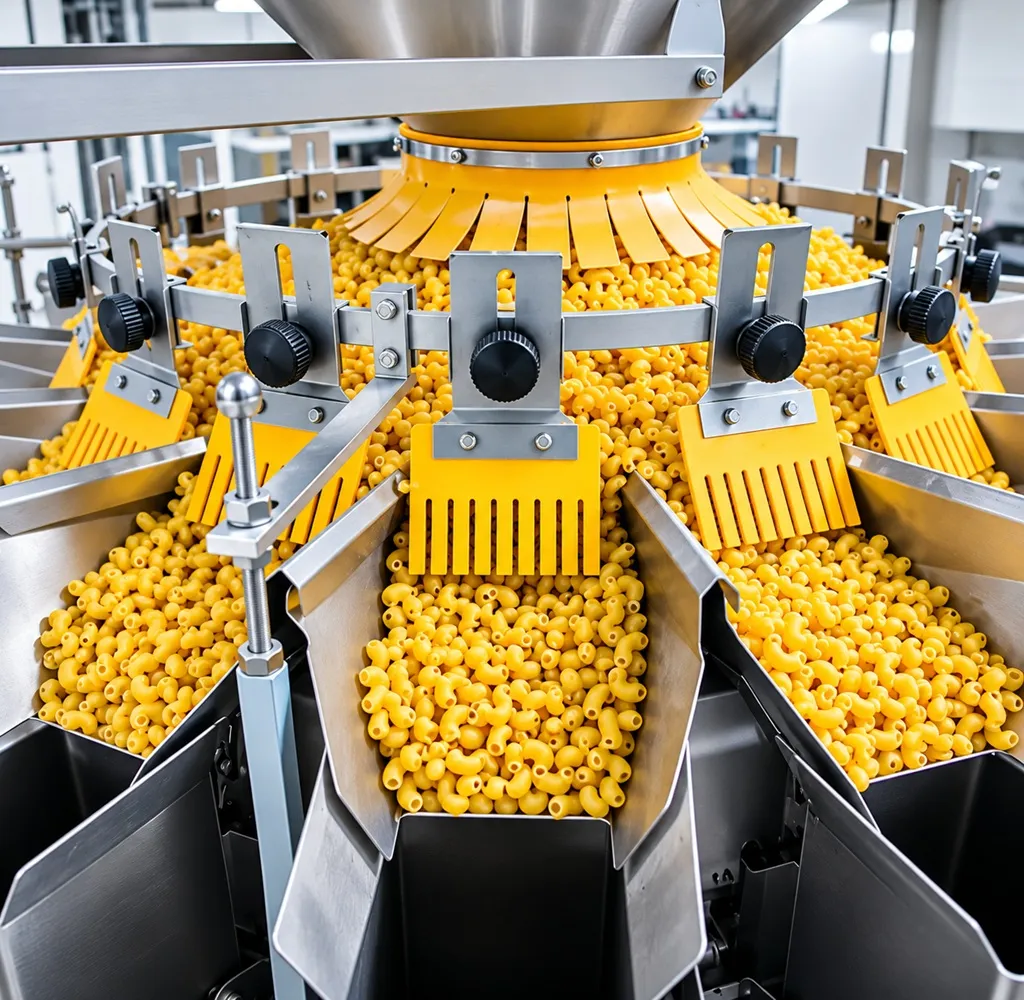
A suitable pasta packing machine can automate product weighing, filling, and pouch sealing according to the selected packaging format.
Different products may require different handling arrangements. Short-cut pasta such as macaroni and penne can use suitable weighing and filling systems, while long pasta such as spaghetti may require dedicated feeding and packing arrangements.
Before selecting packaging equipment, manufacturers should consider:
-
Product shape and handling characteristics
-
Required pack weights
-
Pouch dimensions
-
Packaging material
-
Filling accuracy
-
Sealing requirements
-
Target packing speed
-
Integration with the production line
The packaging section should be able to handle the practical output of the drying and cooling stages. Matching these capacities helps maintain a balanced production flow.
How Automation Connects Production, Drying, and Packaging
Automation becomes more valuable when different machines are planned as parts of one system.
For example, the extrusion section forms the pasta, conveyors transfer the product, the dryer manages moisture removal, and packaging equipment prepares the finished product for dispatch.
When these stages are coordinated, manufacturers can improve process organization and reduce unnecessary manual product handling.
A connected system can also make it easier to monitor important production parameters and identify areas where operational improvements may be needed.
However, buyers should confirm the actual automation scope of the proposed equipment. They should understand which processes are controlled automatically, which require operator input, and how the different machines communicate or coordinate with one another.
What to Check When Comparing a Pasta Machine Exporter
Selecting a reliable pasta machine exporter is an important decision for businesses purchasing equipment for domestic or international manufacturing projects.
Export-oriented machinery projects involve considerations beyond the machine's basic specifications. Buyers may need to coordinate technical documentation, shipping, installation, electrical compatibility, commissioning, and spare-parts requirements.
Before placing an order, consider the following:
Product experience: Review the supplier's experience with pasta production, drying, and packaging equipment.
Technical specifications: Request detailed information about capacity, dimensions, utilities, included components, and operating requirements.
Project coordination: Understand whether the supplier can support the complete equipment configuration or only individual machines.
Export documentation: Confirm the documentation and shipping arrangements applicable to the destination country.
Installation support: Clarify responsibilities for installation, commissioning, and operator training.
After-sales assistance: Discuss technical support, maintenance guidance, and spare-parts availability.
These checks can help international buyers evaluate suppliers and reduce uncertainty during equipment procurement.
Why Choose KP AUTOMATIONS for Pasta Machinery?
KP AUTOMATIONS is an Indian manufacturer and exporter of pasta machinery serving commercial and industrial food-processing requirements.
Its product portfolio includes pasta production systems, automatic machinery, drying equipment, packing solutions, dies, and related components.
For manufacturers planning a new facility, the company provides a range of machinery that can be evaluated according to the required products, production capacity, and factory configuration.
Businesses can explore the KP AUTOMATIONS website to review its machinery portfolio and product information.
When discussing a project, buyers should provide details about the pasta varieties, expected output, operating schedule, drying requirements, and packaging formats. A clear technical brief helps establish an equipment proposal that reflects the actual manufacturing objective.
Planning for Long-Term Production Performance
A successful pasta factory needs more than suitable machinery at the time of installation. It also requires consistent operating practices and planned maintenance.
Manufacturers can support long-term performance by establishing:
-
Standard operating procedures for each product
-
Regular machine inspection schedules
-
Cleaning and hygiene procedures
-
Operator training programmes
-
Production and downtime records
-
Quality checks at important processing stages
-
Preventive maintenance routines
These practices help production teams identify recurring issues and maintain better control over day-to-day operations.
As demand increases, manufacturers can also review whether additional extrusion capacity, drying equipment, or packaging machinery is required.
Conclusion
Building an efficient pasta manufacturing facility requires careful coordination between production, drying, and packaging.
A suitable fully automatic pasta making machine can support organized production, while an automatic pasta making machine can help reduce manual intervention and improve process repeatability. The right pasta dryer, pasta continuous dryer, or industrial pasta dryer should be selected according to the intended product and production capacity.
Packaging is equally important. A compatible pasta packing machine helps prepare the finished product for distribution while supporting the overall production flow.
For businesses comparing options from a pasta machine exporter, technical specifications, engineering capability, installation support, and after-sales service should all be part of the evaluation.
KP AUTOMATIONS offers pasta machinery solutions covering production, drying, and packaging for commercial and industrial applications. With appropriate equipment selection and factory planning, manufacturers can build a production facility designed for consistent operation and future development.