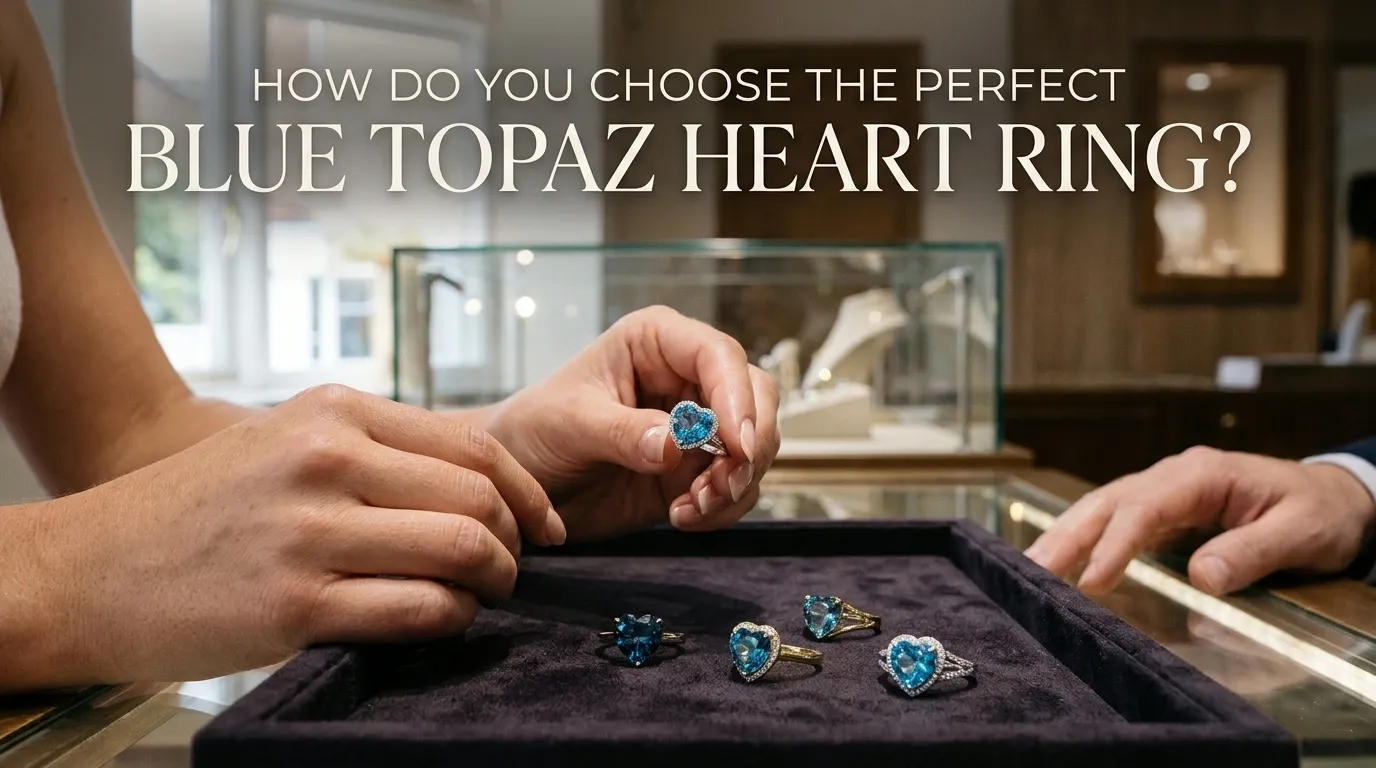
Heart-shaped gemstones are divisive. Some people find the shape too evident, while others fall in love with it immediately. If you are already sold on the idea and working out which stone to buy, blue topaz is worth taking seriously—it delivers real color depth at a price point that most other blue gemstones cannot touch. But the category is broader than it looks. There are three distinct shades of blue topaz, meaningful differences in cut quality, and metal choices that change the entire character of the piece. Shopping for a topaz heart ring without knowing these distinctions is how people end up with something that looks better in the product photo than on their hand.
What Color Grade Does a Topaz Heart Ring Actually Need?
Blue topaz shows up in three well-known grades—sky blue, Swiss blue, and London blue. Sky blue is the lightest, nearly pastel, and it comes off as soft, quiet, and kind of understated. When most people say, "I want a blue stone," they usually picture Swiss blue, which is in the middle, more vivid, and more electrifying. London blue goes deepest, more dark inky teal with a gray hint, and it often looks dramatic, even a little moody.
With a heart cut, shade feels like the main factor, more than you might expect in other shapes. Since the heart is a modified brilliant, light is reflected back toward the observer; the amount of color that appears depends on the initial hue of the stone. Sky blue can seem almost like it has no color in a small size, because the saturation just isn’t high enough to keep the shape looking strong. Swiss blue tends to behave well across different sizes and lighting, so it’s pretty much the most relied-on option. London blue, though, really shines in pictures, and under gallery lighting it looks especially striking, but in a dim restaurant it can even come off near black. See it in person if you can, before you lock in your choice.
The Cut Itself: Symmetry and Windowing
A heart cut needs symmetry to work. The two lobes at the top have to match in size and curve. If one is flatter or wider, the shape reads as lopsided, and nothing else about the ring fixes that. This is worth checking up close if at all possible, since product photography is almost always shot at flattering angles under controlled lighting.
The other thing to look for is windowing. When a stone is cut too shallow, light passes through the center instead of reflecting back, leaving a pale, see-through patch where you would want color. Hold the ring toward a light source and look at the center. It should show brightness and color. If you are seeing straight through to your finger, that stone has windowing, and no setting or metal choice makes up for it.
Metal Choice Changes the Whole Personality of the Ring
Yes, white gold and platinum work nicely with London blue. That cool metal and the dark blue stay in the same tonal range, and the stone ends up looking richer, for that reason. Yellow gold tends to work better with Swiss blue or sky blue, where the warmth in the metal gives just enough contrast to make the whole piece feel sort of vintage. Rose gold has become a go-to for heart rings, especially because that pink against cool blue is a contrast that actually fits a romantic shape.
Sterling silver is the more affordable option, and it works with all three shades. The tradeoff is that silver does tarnish, and it needs periodic polishing, yes. For a ring worn only occasionally, it’s basically a minor inconvenience. But for something worn every day, it starts turning into a routine.
Ring Settings: How the Stone Sits Matters
For heart cuts, prong settings are the norm because they let light enter from several directions, which is how sparkle is created. For a heart specifically, there is usually a prong at each lobe and one at the pointed tip, since that tip is the spot most likely to chip from contact. Bezel settings wrap a metal rim around the stone’s edge. More protective, slightly less brilliant, better for people who are hard on their hands.
Halo settings put a ring of smaller accent stones around the center heart. The practical effect is that a 1-carat stone reads as larger than it is. If you want visual impact without paying for a bigger center stone, a halo setting is an honest way to get there.
Size: Bigger Actually Matters Here
Heart cuts need enough surface area so they “read” as hearts, I guess. When the size drops to about 6 by 6 millimeters, the form starts to blur at a normal viewing distance, so it feels less like a heart and more like… just a sweet outline. With blue topaz, aiming for at least 1 carat helps a lot because the stone gets enough weight/presence that both the shape and the hue show up clearly, not washed out or smeared. Blue topaz isn’t exactly scarce, so per carat pricing stays pretty sane even when you go bigger. And if you’re trying to buy a well-cut, well-colored blue topaz heart in the 1 to 2 carat band, the price is usually way lower than a comparable sapphire or aquamarine heart in the same size. Also, the stone does not really carry a rarity premium; you’re paying for precision in the cut and the color, which is honestly the right thing to be valuing.
What Occasion Are You Buying For?
This kind of shapes the style more than most buyers expect, anyway. A slender sterling silver band with a smaller Swiss blue heart is a pretty solid everyday ring, or maybe a relaxed gift. A heavier gold setting with a larger London blue stone—that one reads as a statement piece, meant for some kind of milestone. Promise rings, anniversary gifts, and fashion rings all need different proportions, not the same exact vibe every time. Blue topaz sits at 8 on the Mohs hardness scale, so it manages daily wear reasonably well. Even so, take it out for strenuous physical labor and avoid using ultrasonic cleaners—don't even test it.
The Bottom Line
Four things decide if a topaz heart ring actually works: the shade of blue you genuinely like when you see it in normal light, a heart cut that is symmetrical and has no windowing, a metal that matches your chosen color, and a stone sized enough so the heart shape stays clear from a few feet away. Those four choices basically cover most of what separates a ring you wear for years from one that ends up in a drawer.