Hana Kobayashi planned her first solo trip to Portugal in 2019 by buying a guidebook at Narita Airport and reading it on the plane. She arrived in Lisbon with a printed itinerary, a pocket map of the metro, and a notebook where she'd written the names of restaurants from a blog post she'd bookmarked three months earlier. She loved the trip. She also ate at exactly one restaurant from that list, spent forty minutes at the airport trying to buy a transit pass through a machine that only spoke Portuguese and Spanish, and missed a last entry time at a palace in Sintra because the guidebook's visiting hours were from 2015.
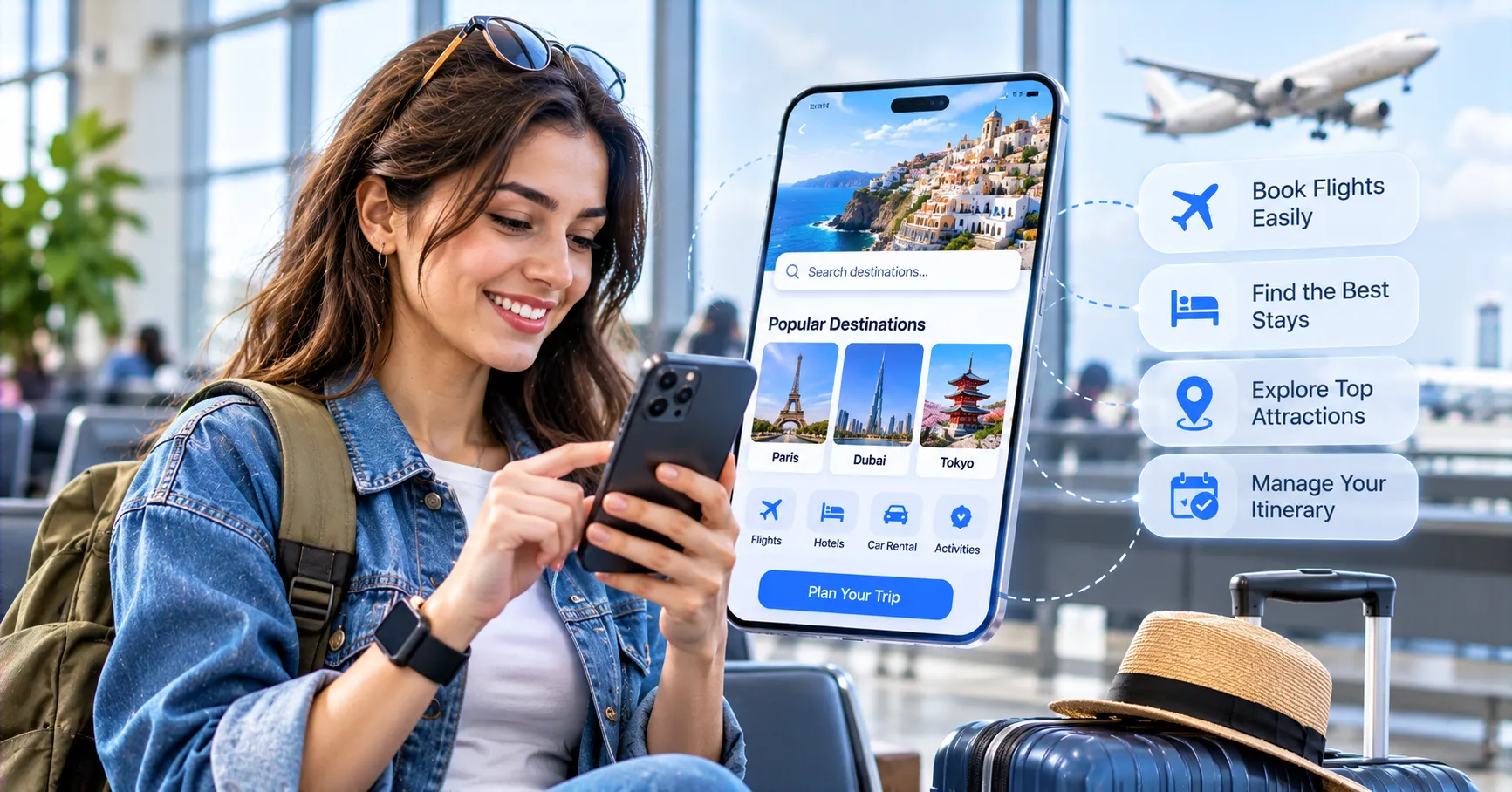
She planned her second trip, to Morocco in 2022, almost entirely on her phone. Not through travel agencies or booking sites she'd used before, but through a combination of apps that handled different parts of the journey in ways that the guidebook never could: a flight aggregator that showed her flexible date pricing, an accommodation app that filtered by neighbourhood rather than star rating, an itinerary builder that pulled her bookings from her email and organized them on a timeline, and an offline map she'd downloaded before leaving home.
The Morocco trip went differently. She still got lost. She still changed her plan three times based on recommendations from people she met. But the information she needed when she needed it was there, and when the riad she'd booked had a water problem and the owner couldn't reach her by phone, the booking app's messaging feature notified her two hours before arrival rather than when she was standing at the door.
She told me later that the guidebook had given her a fixed picture of a place. The apps gave her a live one.
That shift from fixed to live, from planned in advance to responsive to the present, is what a good Travel App Development Company is building toward when it creates tools for the modern traveller. This piece is about how those tools work, what they changed, where they still fall short, and what the space looks like for people building in it.
How Trip Planning Changed Before Anyone Noticed
The travel planning process used to have distinct phases. Research happened weeks or months before the trip through guidebooks, travel magazines, and later websites. Booking happened through agents or by phone. The trip itself unfolded according to whatever had been arranged in advance, with flexibility limited by what you could figure out in an unfamiliar place without reliable information.
The internet collapsed the first two phases into one, which disrupted travel agencies before anyone was quite sure how. TripAdvisor gave millions of people access to unfiltered opinions from recent travellers rather than curated editorial that might be outdated. Booking.com and Hotels.com put direct hotel booking in front of anyone with a browser. Expedia and later Google Flights made price comparison something a consumer could do rather than something only agents had access to.
Mobile apps collapsed the phases further. Research, booking, and navigation are now concurrent activities that happen on the same device throughout the trip rather than in sequence before it. A traveller who discovers a recommended restaurant while waiting for a cable car can open the restaurant's reviews, check its hours, see its location on a map, and book a table for tonight, all within two minutes, while standing on a cobblestone street in Lisbon with the sun in their eyes.
That compression of the planning process is not just convenient. It fundamentally changed the relationship between the traveller and the plan. The plan is no longer fixed at departure. It's a living document that updates as the trip happens.
Flights, Accommodation, and the Price Transparency Revolution
Before flight aggregators made pricing visible, the price you paid for a ticket depended heavily on who you bought it from and when. The information asymmetry between airlines and passengers was enormous and largely invisible.
Google Flights changed this more than any other single tool. Its flexible date calendar, which shows the cheapest fares across a range of departure and return dates in a grid, gave travellers a view of price variation that previously required either an agent's access or a time-consuming manual search. The alert feature, where the app notifies you when a price drops for a specific route, turned the passive consumer into someone who could optimize around price in a way that was previously impractical.
Skyscanner, Kayak, Momondo, and Hopper each built differentiated versions of the same core capability. Hopper, specifically, built a prediction model that tells users whether to book now or wait, backed by a price freeze feature that lets users lock in a price they've found before committing to it. The feature is simultaneously clever product design and a demonstration of how travel apps can convert data into user value that wasn't previously accessible.
Accommodation apps did something similar for lodging. Booking.com and Expedia made inventory visible. Airbnb and Vrbo opened an entirely new category of inventory that didn't exist before. is what made the neighbourhood-level filtering that Hana used possible: search by exact location, by map area, by proximity to a specific landmark, rather than by city and star rating that left travellers uncertain about whether the hotel they'd booked was actually within walking distance of anything they wanted to see.
Navigation and the Map That Knows Where You Are
The printed pocket map was a fixture of travel for decades and had a specific failure mode: it knew where things were but not where you were. Finding yourself on it required triangulation, local knowledge, or patience.
Google Maps and Apple Maps solved the first problem. GPS made real-time navigation possible, which changed what it felt like to be in an unfamiliar city. The turning point wasn't just knowing where you were but knowing how long it would take to walk from where you were to where you wanted to go, by which route, and whether that route passed anything interesting.
Offline map capability was the second major change, particularly relevant to international travel. Maps.me, HERE WeGo, and the offline download feature in Google Maps gave travellers access to full navigation in areas without data coverage, which addressed one of the most stressful experiences in pre-smartphone travel: being lost without connectivity.
Public transit apps made getting around by local transport achievable without deep knowledge of the system. Citymapper integrates metro, bus, ferry, and bike-share data for dozens of cities and shows the whole journey, including walking to and from stops, transfer times, and real-time service alerts. Moovit serves a broader range of cities with similar functionality. The traveller who might have defaulted to taxis because the transit system felt impenetrable can now navigate it without anxiety.
Review Culture and the Decline of Editorial Authority
The guidebook's authority came from experts who had been to places and formed considered opinions. The limitation was that those opinions were fixed in print and represented the experience of a small number of people at a specific moment in the past.
TripAdvisor, Yelp, and Google Reviews replaced editorial authority with aggregated opinion, which had advantages and problems. The advantages were currency, scale, and specificity. A restaurant reviewed last Tuesday by fifty people is more reliably current than a review written eighteen months ago and published six months before you read it. The problems were manipulation, inconsistency, and the particular failure mode where the most-reviewed places crowd out excellent places that simply haven't been reviewed yet.
The travel app landscape has responded to those problems with varying degrees of success. The Infatuation built a trusted editorial voice alongside user reviews. Culture Trip combined editorial content with practical booking for a specific demographic of independent travellers. EatWith connects travellers with home dining experiences that review platforms don't capture at all.
The honest assessment is that review aggregation works best for well-travelled cities and well-established venues, and works poorly for off-the-beaten-path experiences and newly opened businesses. The traveller who wants to eat where locals eat still needs local knowledge or significant research effort, because the most-reviewed restaurants in any tourist city are largely the ones that have optimized for being discovered by tourists.
Itinerary Building and the Connected Trip
The practical challenge that itinerary builder apps address is data fragmentation. A traveller who has booked a flight through Google Flights, a hotel through Booking.com, and a train through the rail operator's own site has three separate booking references in three separate emails. Keeping track of them and understanding the relationship between them requires either excellent memory or a lot of tabs.
TripIt, Wanderlog, and similar apps solve this by either monitoring the user's email for travel bookings or accepting manual entry, then organizing everything into a single timeline. TripIt's Pro version adds real-time flight alerts, seat tracking, and alternative flight suggestions when a connection is at risk. Wanderlog adds collaborative features that let trip groups contribute to and view the same plan simultaneously.
The collaborative dimension is worth noting because travel is predominantly a social activity. A group of four friends planning a trip together have always needed a shared source of truth for the itinerary, which previously meant one person owning the spreadsheet or the WhatsApp thread becoming the de facto itinerary through accumulated messages. Apps that give the whole group simultaneous edit access to a shared plan solve a real coordination problem.
Where Travel Apps Still Fall Short
Honesty about the limits matters here because the travel app landscape overclaims regularly.
Personalization is the most overpromised feature. Most recommendation algorithms optimize for what many users of your type have enjoyed, which produces recommendations for well-visited places rather than genuinely tailored ones. A system that recommends the same five museums in Amsterdam to everyone who indicates an interest in art has personalized nothing. The human recommendation from someone who knows you remains more valuable than algorithmic personalization in most travel contexts.
Hyperlocal and experiential content is consistently underdeveloped. Apps are good at helping travellers find major attractions, well-reviewed restaurants, and established accommodation. They're poor at helping travellers find the neighbourhood bakery that the locals actually go to, the small arts venue with an excellent program, or the specific beach access point that isn't on any map but is a ten-minute walk from the trail.
Connectivity dependency remains a genuine issue. Travel involves irregular connectivity: airport lounges with capped WiFi, rural accommodation with weak signal, public transit that goes underground. The apps that work best in travel contexts download aggressively when connected and degrade gracefully when not, but the gap between connected and disconnected experiences is still significant across most travel apps.
What Builders Are Still Missing: The Opportunity Layer
For anyone evaluating mobile app ideas in the travel space, the most interesting opportunities are not in the well-served categories of flights, hotels, and navigation. Those are competitive to the point of being dominated by incumbents with network effects that are genuinely hard to overcome.
The underserved opportunities are mostly at the intersection of travel and other life contexts: slow travel for remote workers who need reliable connectivity and workspace information as much as sightseeing. Family travel with specific infrastructure around activities for different age groups, accessibility requirements, and child-friendly accommodation filtering that goes beyond "family room available." Solo female travel with safety-specific information and community features that generic apps don't surface. Niche interest travel for birders, cyclists, culinary enthusiasts, and photographers, where the relevant infrastructure is completely different from the conventional tourist infrastructure.
The other underserved layer is post-trip. Travel apps overwhelmingly serve the planning and during-trip moments and almost completely ignore the post-trip relationship between the traveller and the places they visited. Someone who loved a neighbourhood in Porto and wants to follow its restaurant scene from home has essentially no native tool for that. Someone who made friends with a local guide and wants to remember what they recommended has no structured way to store that in a travel context.
These are product design problems waiting for people who have lived them, which is usually how the best travel products get made.
What It Costs to Build in This Space
The travel app market is both competitive and large enough that well-scoped entrants can build sustainable products without competing head-to-head with Google Flights.
A focused first version addressing a specific underserved need, such as collaborative itinerary building for group travel, niche interest travel recommendations, or slow travel workspace discovery, might start in the range of thirty-five to sixty thousand dollars for a properly built mobile app. A more comprehensive platform with flight and accommodation search, real-time booking integration, offline maps, and social features runs between one hundred and two hundred thousand. Travel apps that require deep API integrations with global distribution systems, real-time pricing feeds, and payment processing for the full booking funnel can exceed that substantially.
Ongoing costs in travel include API fees from the data providers that make the app useful: mapping APIs from Google or HERE, flight data from Skyscanner's API or Amadeus, accommodation inventory from Booking.com's affiliate API. These costs are modest in early-stage products and significant at scale, which means the financial model needs to account for the data costs that come with the usage the product is trying to achieve.
Hana's Next Trip
Hana is planning a trip to Uzbekistan in the spring. She's using an itinerary app, an offline map download she'll complete before she flies, and a small notebook for things she discovers that the apps don't capture.
She told me the notebook still matters. Not because the apps don't work but because some of the best things she's found, the specific corner in a Lisbon neighbourhood, a tile shop in Fez she almost walked past, a family in Morocco who invited her to a celebration she hadn't planned for, don't fit into any app's data model. They happen in the space the apps leave open.
The apps changed what she can know before she arrives and what she can find while she's there. The notebook holds what happens in between, and what happens in between is usually the part she remembers most.
Good travel apps understand this. The best ones are designed to be useful without being complete, to handle the infrastructure so the traveller can be present for the rest.