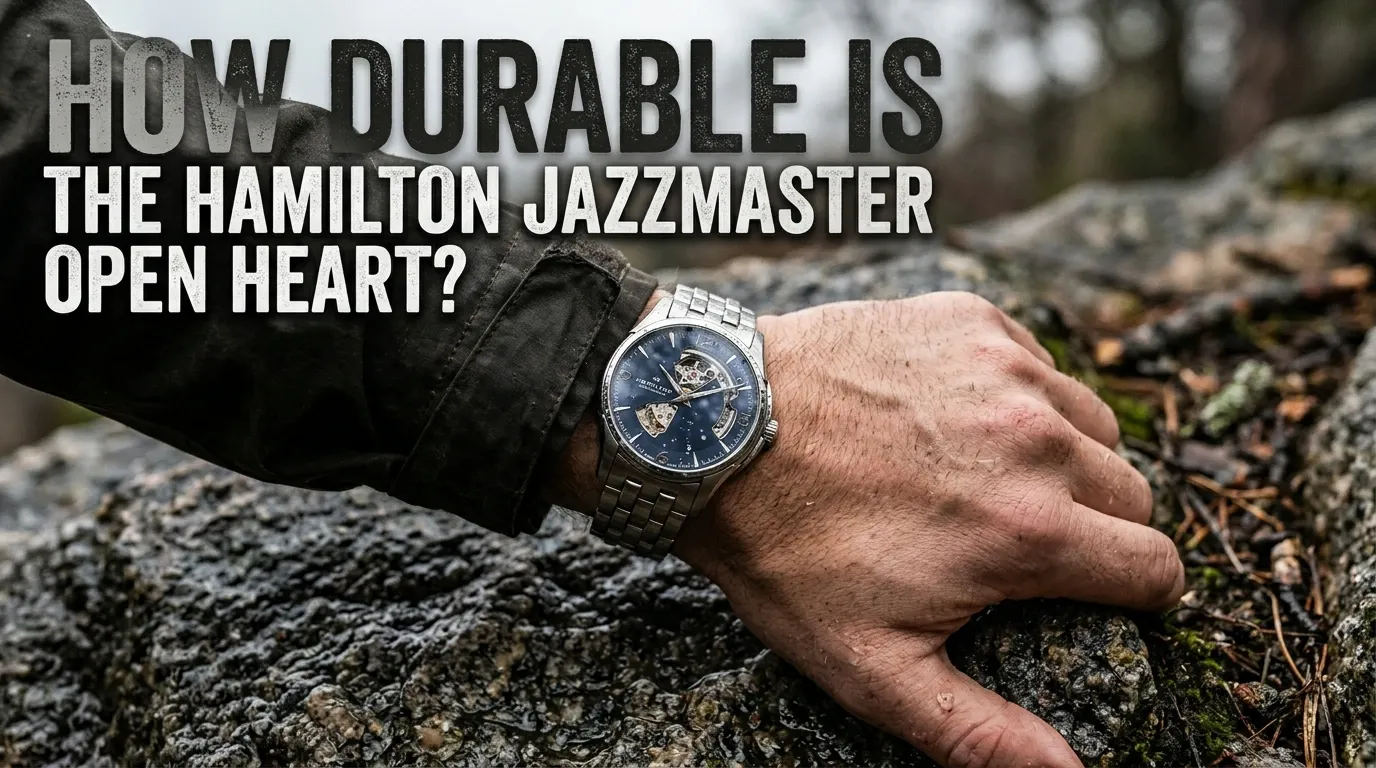
Most watches in the 1,000–1,300 range ask you to pick between looks and substance. The Hamilton Jazzmaster Open Heart is unusual because it leans hard into aesthetics—that exposed escapement, the dial cutout, and the visible balance wheel—and still manages to back it up with materials and engineering that hold up to daily use. So how durable is it, really? The answer depends on which part of the watch you are asking about.
The Case and Crystal of the Hamilton Jazzmaster Open Heart Provide Important Insights
The case is made from 316L stainless steel, a corrosion-resistant alloy commonly found in Swiss watchmaking within this price range. It withstands skin contact, humidity, and the typical bumps from tougher surfaces without exhibiting that frustrating tendency to degrade in appearance with normal daily use. While it may not be particularly dramatic or exotic, it certainly does not fall into the category of inferior materials either.
And then the crystal—that's where the watch actually earns its points. Hamilton puts sapphire glass on the Jazzmaster Open Heart, with an anti-reflective coating on both sides, like the front and back. Sapphire is at 9 on the Mohs scale; only diamond really sits above it. So in everyday life it stays basically scratch-free for a long while. Desk surfaces, jacket pockets, and even wood furniture—none of it makes a difference. You’d need material with real diamond particles to leave a mark, and honestly most wrists won’t meet that on a Tuesday. Furthermore, the double-sided anti-reflective (AR) coating offers more than just an aesthetic appeal; it effectively reduces glare from various angles. This ensures that the open heart cutout remains clear and legible, rather than appearing somewhat washed out under bright overhead lighting.
Quick note about the caseback: it’s not a typical solid back. It’s an open display window, also sapphire, sealed and secured properly. It doesn’t “weaken” the case, but you can see the movement from both sides, and that’s basically the whole design idea, at least as intended.
The H-10 Movement: What 80 Hours of Power Reserve Actually Means
Hamilton created the H-10 caliber in-house, operating within the Swatch Group ecosystem. The practical highlight is the power reserve: 80 hours. Most automatic movements in watches under around $2,000 hover in the 38- to 48-hour range. Those watches often need either wearing or a manual wind if they sit through a weekend. The H-10 doesn’t really do that. Put it on the nightstand Friday evening, grab it Monday morning, and it’s still going.
This feature matters for durability in a way people sometimes gloss over. When a mainspring runs fully down and then resets, there’s wear involved. A longer power reserve means fewer full run-down cycles over the movement’s life. It’s not the only factor, but it’s a real contributor to longevity. It also means fewer moments where you find the watch stopped, rush setting the time, and wind the crown with more force than you needed.
It also uses a Nivachron balance spring. Nivachron is that titanium-based alloy Hamilton picked because steel balance springs can get thrown off by magnetic fields. Laptop fans, phone speakers, bag clasps, and induction cooktops… these things can push a steel spring into timekeeping drift. The Nivachron spring fights that. It may not be a flashy feature to boast about, but if you wear this watch daily across various environments, it contributes to maintaining steadier accuracy than what is sometimes achieved with standard spring materials.
Water Resistance: Honest About What It Covers
The rating is 5 bar, or 50 meters if you’re thinking in static pressure terms. That basically covers rain, hand washing, splash moments, and accidental drops into a sink. It does not cover swimming, snorkeling, or anything involving long submersion. Hamilton designed the Jazzmaster line for dressy and everyday wear, not water sports, and the 50-meter rating matches that reality pretty well.
Where people get tripped up is treating water resistance like it’s forever. It isn’t. The rubber gaskets that keep the seal tight age, and a watch rated at 50 meters when it leaves the factory can be noticeably less capable after five years, especially without any maintenance. Getting a pressure test every 2 to 3 years at a qualified watchmaker keeps the rating "true." This isn’t a Jazzmaster-only situation; it applies to almost any water-resistant watch regardless of price, but it’s worth remembering.
Bracelet and Strap: The One Part That Actually Wears Out
On the stainless steel bracelet models, the build is pretty solid, and the folding or butterfly clasp holds tension well for years. With heavy daily wear you can get some stretch over time, and sometimes individual links need tightening. That’s not weird; it’s normal behavior for steel bracelet watches across price points.
Leather strap versions are a totally different story. Sweat, moisture, and friction slowly do visible damage to leather, and no leather strap typically lasts longer than the watch itself. That’s not a "fault"; it’s simply the nature of leather. Replacement straps are affordable and easy to source for the standard 20–22mm lug widths this model uses, so it’s more of a mild recurring cost than an actual durability issue with the watch.
Serviceability and Long-Term Ownership
Since Hamilton is part of the Swatch Group, service infrastructure exists in most major markets. Parts availability for a current production line usually isn’t a problem. The H-10 movement also responds well to normal servicing: cleaning, lubrication, and gasket replacement. A watchmaker who already understands Swiss movements can handle it without needing some weird specialized gear. Hamilton includes an international warranty for two years from purchase, and some authorized retailers throw in extra coverage on top of that.
The Hamilton Jazzmaster Open Heart is not a fragile showpiece. The sapphire crystal, corrosion-resistant case, magnetic-resistant movement, and global service network add up to a watch that holds up to genuine daily wear across years—not just careful weekend use. Buy it for how it looks, but you are not sacrificing anything on the practical side to do so.