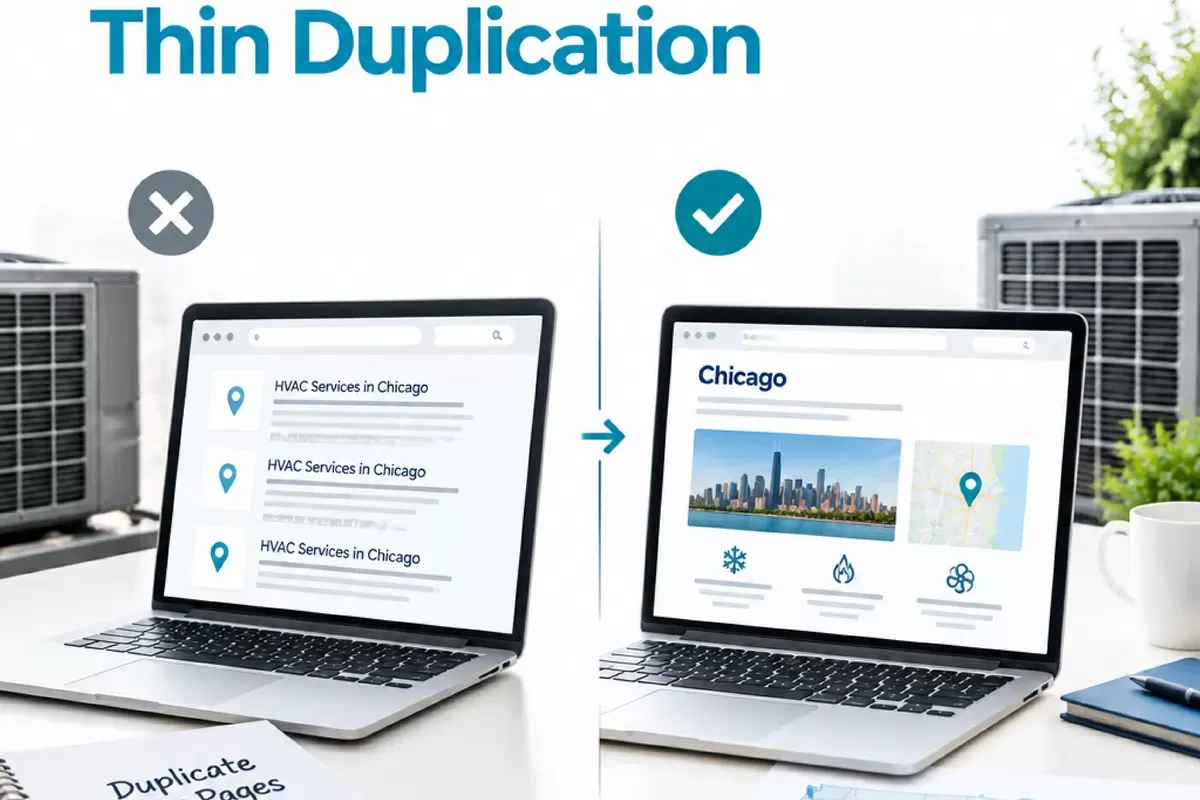
For HVAC companies in the United States, adding a page for every town in a service radius can look like a quick way to appear in more local searches. But if those pages only swap the city name, they give homeowners little reason to choose the business or search engines much useful information. A better multi-location SEO plan starts by deciding which places deserve a page, then gives each page a clear purpose and details the company can verify.
This approach helps business owners build local visibility without publishing near-duplicates. It also makes it easier to connect city pages to the HVAC services people are actually looking for, from AC repair to furnace installation.
Decide which locations merit an HVAC city page
A location deserves its own page when the company has a real service presence there and can say something useful about serving that market. Start with operational facts, not a keyword list. Check dispatch records, service-area policies, technician coverage, and the places where the business can reliably schedule work. A town included in a broad service radius is not automatically a strong standalone page candidate.
Ask a few practical questions before creating a URL:
- Does the company regularly accept and fulfill jobs in this location?
- Can the page describe service availability accurately, including any limits?
- Is there distinct information for local customers, such as relevant equipment, housing needs, or access considerations?
- Can the business provide useful local proof, such as completed work or customer reviews tied to that place?
- Will this page help a visitor take the next step more clearly than a general service-area page?
If the answers are mostly no, a broader service-area page may be more helpful. It can list the communities the company serves without creating a thin page for each one. This is especially useful for smaller towns that share the same dispatch area and service details. A page should exist because it serves the reader, not simply because a location phrase can be added to a title.
Also review whether two nearby city pages would offer meaningfully different information. If the only difference is the place name, phone number, and a repeated paragraph, combine them or improve the content before publishing. The goal is not a maximum page count. It is a clear set of pages that reflects where the HVAC company works and what customers need to know.
Build United States city pages with useful local details
Local searches in the United States often include a city, ZIP code, or “near me.” A well-built page helps answer the follow-up questions behind that search: Does this company serve my location? Can it handle the HVAC issue I have? What happens when I contact it? State those basics plainly near the top, and make sure the service boundary matches the company’s actual operations.
Then add local information only when the business can stand behind it. Depending on the market, that could include verified details about the types of homes or HVAC systems technicians commonly encounter, local scheduling or access considerations, or the services available in that location. Climate can affect customer needs, but avoid broad claims about weather or equipment unless they genuinely apply to the specific market and the company can support them.
Useful proof is specific and accurate. For example, a company might describe a type of work it performs in a location, explain the process for booking, and include a review from a customer there if it has permission and the review is genuine. Do not invent local projects, testimonials, staff locations, or service guarantees. If the business has no location-specific proof yet, focus on clear service information rather than dressing up generic copy as local experience.
Keep core business details consistent across the website and the company’s Google Business Profile (GBP). For a service-area business, use the profile to represent the real business and its eligible service area. Do not create extra profiles for individual cities just to pursue map results. Keep the business name, phone number, and address details accurate wherever they appear, and do not imply a staffed office exists at an address if it does not.
A city page earns its place by answering local customer questions with accurate information, not by repeating a location keyword.
Connect city pages to services, then check performance
A location page and a service page do different jobs. The city page explains where the company works and what customers in that location should know. A service page explains the HVAC work itself, such as AC repair or furnace installation. Link between them when the connection is useful: a city page can point to the relevant service pages, while a service page can direct visitors to locations the company genuinely covers.
Use clear link text that tells visitors what they will find. Avoid adding a block of links to every city and every service on every page. That can make navigation harder to use and blur the site’s structure. Instead, group locations sensibly, link to the most relevant service details, and make sure visitors can reach contact or booking information without hunting.
When the site has many location pages, keep a simple planning sheet with each page’s URL, target location, covered services, local details to verify, and links to related service pages. Record who will review the information and when. This catches common problems: outdated service boundaries, conflicting phone numbers, duplicated sections, and pages that mention services the business does not offer in that location.
Track more than organic visits. Review search visibility for relevant location and service queries, GBP activity where available, calls or form submissions, and whether those leads match the work the company wants. Compare pages over time, but account for differences in demand, season, and service availability. A page that attracts visits but no relevant inquiries may need clearer service information or a more accurate location focus. Rankings alone do not show whether the page is useful to the business.
For a larger site or a location plan that is difficult to maintain, expert help can bring technical fixes, local visibility, content planning, ethical link building, and reporting tied to leads and revenue into one process. SEO Deep Insights works across SEO, Answer Engine Optimization (AEO), and Generative Engine Optimization (GEO). These approaches can support clear, structured information for search engines and AI-generated answers, though no page or tactic guarantees placement.
Before publishing the next city page, verify that the company truly serves the location, write down what makes the page useful to local customers, and connect it to the right HVAC services. If those details are not available, improve the broader service-area page first. That restraint keeps the site easier to trust, easier to navigate, and more manageable as the business grows.